
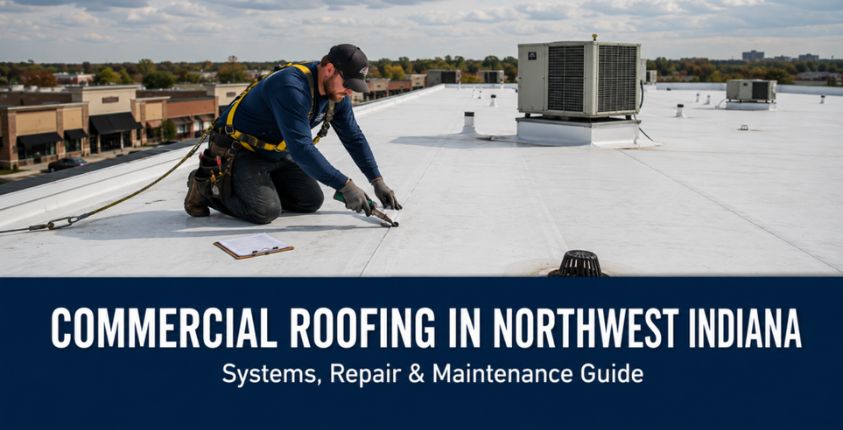
Quick answer: Commercial roofing differs from residential roofing in the systems used (low-slope membranes like TPO and EPDM instead of asphalt shingles), the inspection schedule required (typically twice a year plus after major storms), and the operational priority of minimizing business disruption during repairs. Common warning signs a commercial roof needs attention include ponding water, membrane seams pulling apart, and interior leaks near roof penetrations like HVAC units and vents.
If you manage or own commercial property in Northwest Indiana, retail space, a warehouse, an office building, a multi-unit facility, your roof operates under different rules than a house does. Commercial roofing in Northwest Indiana has to deal with the same lake-effect snow load, wind, and freeze-thaw cycling that residential roofs face, but on a larger scale and with a lot more riding on it operationally when something goes wrong. This guide covers the systems actually used on commercial buildings here, how to tell when one needs commercial roof repair, and what a maintenance program should actually include.
Commercial Roofing vs. Residential Roofing: What’s Actually Different
| Residential Roofing | Commercial Roofing | |
|---|---|---|
| Roof slope | Pitched | Typically low-slope or flat |
| Common materials | Asphalt shingles | TPO, EPDM, modified bitumen, metal |
| Inspection frequency | Usually as-needed | Recommended 2x per year, plus post-storm |
| Repair urgency driver | Comfort, property value | Business continuity, inventory/equipment protection |
| Access | Ladder | Often requires roof access equipment |
| Typical lifespan | 20-30 years (asphalt) | 15-30 years depending on system |
The biggest practical difference for a property owner: a residential roof leak is a homeowner’s problem. A commercial roof leak over inventory, server equipment, or a retail floor is an operational and financial one, which changes how repairs get prioritized and scheduled.
Commercial Roofing Systems Used in Northwest Indiana
TPO (Thermoplastic Polyolefin)
A single-ply membrane roofing system that’s become one of the most common choices for commercial low-slope roofs. It reflects heat well, resists UV exposure, and its seams are heat-welded rather than glued, which tends to hold up better over time than adhesive-based seams.
EPDM (Rubber Roofing)
A synthetic rubber membrane with a long track record on commercial buildings. It handles temperature swings well, which matters given how much Northwest Indiana’s seasons vary, and it’s generally more affordable than TPO, though it doesn’t reflect heat as effectively.
Modified Bitumen
An asphalt-based system reinforced with fiberglass or polyester, applied in layers. It’s a durable, well-understood option, often chosen for buildings that need a system with a long history of real-world performance data behind it.
Metal Roofing
Standing seam and other metal systems show up on commercial buildings that want a longer lifespan and don’t mind the higher upfront cost. Metal handles Northwest Indiana’s wind and snow load well, and it’s a strong option for buildings with steeper commercial slopes rather than fully flat roofs.
| System | Typical Lifespan | Best For |
|---|---|---|
| TPO | 20-30 years | Heat reflectivity, energy cost reduction |
| EPDM | 20-25 years | Budget-conscious projects, temperature flexibility |
| Modified Bitumen | 15-20 years | Proven, long-track-record durability |
| Metal | 30-50 years | Long-term investment, higher wind/snow loads |
Signs Your Commercial Roof Needs Attention
- Ponding water that doesn’t drain within 48 hours after rain, a sign of drainage or slope issues that can accelerate membrane breakdown
- Membrane seams lifting or separating, especially around HVAC units, vents, and roof edges
- Interior water stains or leaks, particularly near roof penetrations, which are the most common failure point on commercial roofs
- Visible blistering or bubbling in the membrane surface
- Increased energy costs without an obvious cause, sometimes a sign of failing insulation under the roofing system
- Debris accumulation in drains, which can cause the ponding issue above if left unaddressed
What a Commercial Roof Maintenance Program Should Include
Unlike most residential roofs, commercial roofs generally benefit from a scheduled maintenance program rather than a wait-until-something-leaks approach. A reasonable program typically includes:
- Biannual inspections, usually spring and fall, checking membrane condition, seams, flashing, and drainage
- Post-storm inspections after any significant wind or hail event, since commercial roofs cover more surface area and can sustain damage that isn’t visible from ground level
- Drain and gutter clearing to prevent ponding water issues before they start
- Documented condition reports over time, which matter both for planning capital expenses and for supporting insurance claims if storm damage occurs
- Prompt minor repairs, since a small membrane issue caught early is a fraction of the cost of the water damage it causes if ignored
If your commercial building has taken storm damage, our hail and wind damage guide covers what wind and hail damage looks like, much of which applies to commercial membrane roofing as well as residential shingles.
Repair vs. Replace on a Commercial Roof
The math on commercial roof repair versus full replacement works differently on commercial buildings than on houses, mainly because of scale and business disruption cost. A repair on a house might mean a few dozen shingles. A repair on a commercial building can mean addressing a failing seam across a hundred linear feet of membrane, which changes both the cost calculation and the urgency.
Commercial roof repair generally makes sense when: damage is localized to a specific area, seams, a penetration point, isolated storm damage, and the rest of the membrane is in good condition with useful life left. Catching an issue at this stage is almost always the cheaper long-term path.
Replacement becomes the better call when: the roofing system is approaching or past its expected lifespan, damage is widespread across multiple sections, or repeated repairs are starting to cost more cumulatively than a planned replacement would. At that point, continuing to patch a system nearing the end of its service life often costs more over two or three years than replacing it once.
A legitimate inspection should walk you through which category your roof falls into, with documentation, not just a recommendation. You can see the range of what we handle on our roofing services page and our metal roofing page if that’s the system under consideration.
What Commercial Roof Repair Actually Costs to Delay
It’s worth being direct about the cost of waiting. A minor membrane seam issue caught early is typically a same-day repair. Left alone through a season of freeze-thaw cycling and wind, that same issue often turns into a saturated insulation layer underneath the membrane, which usually means replacing a much larger section than the original problem, sometimes the insulation across an entire roof plane, rather than just resealing a seam. The commercial roof repair that would have cost a few hundred dollars becomes a multi-thousand dollar insulation and membrane replacement, plus whatever interior damage occurred while the leak was active. This is the core argument for the biannual inspection schedule covered above, not because every inspection finds something, but because the ones that do almost always save real money.
Minimizing Business Disruption During Repairs
For a commercial property, the roofing work itself is often less disruptive to plan around than the schedule it happens on. A contractor doing commercial roofing in Northwest Indiana should be able to work around your operating hours, whether that means early morning starts, weekend work, or phased repairs that keep sections of the building operational while others are being worked on. Ask about this directly before signing a contract, since not every contractor structures their crews and scheduling to accommodate it.
This matters more for a retail storefront or a facility with customer foot traffic than it does for, say, a warehouse with more flexible access. Be specific with your contractor about what disruption actually looks like for your business, whether that’s noise during business hours, staging equipment in a parking lot customers use, or needing a section fully sealed before end of day, and get that written into the project plan rather than assumed.
Questions to Ask a Commercial Roofing Contractor
- How many commercial roofing projects have you completed, and on which systems specifically (TPO, EPDM, modified bitumen, metal)?
- Can you work around our business hours, and what does that do to the project timeline?
- What does your commercial roof maintenance program actually include, and how often do inspections happen?
- How do you document damage and condition for insurance and capital planning purposes?
- What’s the warranty, and does it cover labor as well as material?
FAQ
What is the most common commercial roofing system?
TPO has become one of the most widely used commercial roofing systems due to its heat reflectivity, welded seams, and relatively lower installation cost compared to some alternatives. The right choice for a specific building still depends on budget, roof slope, and expected lifespan needs.
How often should a commercial roof be inspected?
Twice a year is standard, typically spring and fall, plus an additional inspection after any major wind or hail event. Buildings in areas with significant seasonal weather swings, which includes most of Northwest Indiana, generally benefit from staying on this schedule rather than inspecting only when a problem is already visible.
How long does a commercial roof replacement take?
It depends heavily on the size of the building and the system being installed, ranging from a few days for a small building to several weeks for a large facility. A contractor experienced with commercial work should be able to give a realistic timeline and phase the work to minimize disruption.
Does commercial roofing insurance work differently than residential?
Commercial property policies vary significantly by carrier and by the specific building use, and coverage details depend entirely on your policy. Our storm and insurance services page covers how we support documentation for storm-related commercial claims, though coverage determinations are always made by your insurance carrier, not by a contractor.
Get a Commercial Roofing Assessment
We handle commercial roofing in Northwest Indiana for property owners in Michigan City and the surrounding area, from routine maintenance inspections to full system replacement. If you need an inspection, a maintenance program, or a repair versus replacement assessment, request a free inspection. We’ll walk the roof, document what we find, and give you a straight answer scheduled around your business, not ours.