
If your siding is cracked, faded, or letting water behind it, you’re probably comparing options right now and getting three different answers from three different contractors. That’s normal. Siding installation in Michigan City means dealing with lake-effect weather that most siding wasn’t originally tested for, and the material that works great on a house forty miles inland isn’t automatically the right call on a home a few blocks from Lake Michigan.
This guide walks through the three materials homeowners here actually choose between, what each one handles well and where it struggles, and what to ask before you hire a siding contractor in Michigan City.
Why Siding Choice Matters More Near the Lake
Standard siding installation guides written for a national audience tend to gloss over regional weather, and that’s exactly the part that matters most here. Michigan City homes deal with wind-driven rain off the lake, humidity swings, and winters that alternate between deep freezes and thaws multiple times in a season. Siding that’s rated for “average” conditions can warp, crack, or let moisture in behind the panels faster than it would somewhere with more predictable weather.
That’s not a reason to panic about your siding choice. It’s a reason to actually think about material, not just color and price, before committing.
Vinyl Siding
Vinyl is the most common siding installation in Michigan City, and for good reason, it’s the most affordable option upfront and it’s genuinely low maintenance. You’re not staining or repainting it, and modern vinyl holds up reasonably well against moisture since water doesn’t soak into the material itself.
Where it struggles: vinyl can become brittle in extreme cold, and Michigan City winters get cold enough that older or lower-grade vinyl siding sometimes cracks on impact, a stray branch, hail, even an errant baseball. Wind is the other consideration. Vinyl siding needs to be installed with the right amount of expansion room, since it contracts and expands more than some other materials with temperature swings, and installation shortcuts here are one of the more common reasons vinyl siding fails early near the lake.
Best for: homeowners who want the most budget-friendly siding installation option and don’t mind a more limited color and texture selection compared to fiber cement.
Fiber Cement Siding
Fiber cement is a composite of cement, sand, and cellulose fibers, and it’s become a popular upgrade for homeowners who want something more durable than vinyl without going to a full wood replacement. It holds paint well, resists impact better than vinyl, and doesn’t warp or rot the way wood can.
Where it struggles: fiber cement is heavier and more labor intensive to install correctly, and improperly sealed joints or cuts can let moisture in over time, which matters more here given the humidity coming off the lake. It also costs more upfront than vinyl, both in material and installation labor.
Best for: homeowners planning to stay in the home long term who want a material that holds up to lake weather with less risk of impact damage, and who don’t mind repainting every decade or so to keep the finish fresh.
Engineered Wood Siding
Engineered wood siding gives you the look of traditional wood siding with better resistance to moisture and pests than solid wood, since it’s manufactured with a resin-treated core and a protective overlay. It’s a middle ground between the classic wood look homeowners in Michigan City’s older neighborhoods often want and the practical need for something that won’t rot after a decade of lake humidity.
Where it struggles: engineered wood still needs more maintenance than vinyl or fiber cement, sealed edges, occasional refinishing, and proper installation to keep moisture from getting into any cut or seam. It’s not a install-and-forget material the way vinyl is.
Best for: homeowners in older or historic-style homes where an authentic wood look matters, and who are willing to keep up with periodic maintenance in exchange for that appearance.
Side by Side
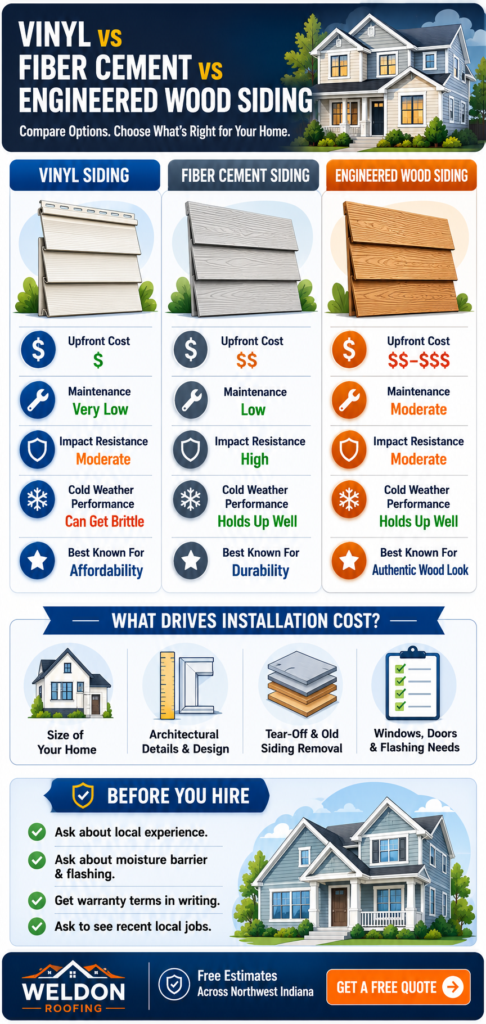
| Vinyl | Fiber Cement | Engineered Wood | |
|---|---|---|---|
| Upfront cost | Lowest | Higher | Mid to high |
| Maintenance | Very low | Low, repaint every 10-15 years | Moderate, needs periodic sealing |
| Impact resistance | Moderate, can crack in cold | High | Moderate |
| Best known for | Affordability + low upkeep | Durability + paintability | Authentic wood look |
| Cold weather performance | Can become brittle | Holds up well | Holds up well if properly sealed |
What Drives the Cost of Siding Installation
No two siding jobs cost the same, but a few things consistently move the price. Material is the biggest factor, vinyl sits at the low end, fiber cement in the middle to upper range, and engineered wood is usually comparable to or slightly above fiber cement depending on the product line. Home size and the amount of surface area being covered matters obviously, but so does the condition of what’s underneath. If the old siding needs to be fully torn off and the sheathing underneath has moisture damage, that repair work gets added to the siding installation cost before a single new panel goes up.
Trim, corners, and how many windows and doors need to be flashed also affects labor time. A straightforward rectangular home costs less to side than one with a lot of architectural detail, dormers, bump-outs, multiple roof lines meeting the wall. None of this means you should expect a lowball estimate to be wrong, it just means a real number only comes from someone actually looking at your home, not a generic per-square-foot quote over the phone.
What Actually Matters for a Lake Michigan Home
If you’re not sure which of these fits your situation, the honest answer is that it depends less on which material is objectively “best” and more on what you’re optimizing for. If minimizing cost and upkeep is the priority, vinyl siding installation is still the reasonable default for most Michigan City homes, and modern vinyl performs better in cold weather than the vinyl from twenty years ago. If you’ve had siding fail early before, cracked, warped, or pulled away from the house, fiber cement is usually the upgrade worth the extra cost, since it’s simply tougher against the kind of wind and impact this area sees.
Engineered wood tends to come up most with homeowners restoring or maintaining the look of an older Michigan City home where vinyl or fiber cement would look out of place. It’s a legitimate option, it just comes with a maintenance commitment the other two don’t.
Installation Matters More Than the Material
Here’s something that doesn’t get said enough: a mid-tier material installed correctly will outlast a premium material installed poorly. Siding installation in Michigan City needs proper flashing around windows and doors, correct fastening that accounts for expansion and contraction, and enough of a moisture barrier behind the siding to handle wind-driven rain. A contractor who cuts corners on any of these steps can make even fiber cement fail early, and a contractor who does it right can get vinyl siding to perform well past its expected lifespan.
This is really the deciding factor in who you hire, more than which specific material they push hardest.
Questions Worth Asking Before You Hire a Siding Contractor
How many siding installations have you actually completed in Michigan City specifically? Local experience matters here because of the lake weather, not just general siding experience somewhere else. A siding contractor in Michigan City who’s worked the area for years has already seen how each material actually holds up through a real winter here, not just on paper.
What moisture barrier and flashing approach do you use? If a contractor can’t explain this clearly, that’s worth noting. This is where most premature siding failures actually start.
What’s the warranty, and does it cover labor or just material? Material warranties are common. Labor warranties, which cover it if the siding was installed incorrectly, are the ones that actually protect you.
Can I see recent local jobs? A siding contractor in Michigan City who’s done real work here should be able to show you actual homes, not just a stock photo gallery.
How do you handle repair versus full replacement? Sometimes a section of damaged siding can be repaired instead of replacing the whole side of a house. A contractor who always recommends full replacement regardless of the damage is worth a second opinion.
FAQ
How much does siding installation cost in Michigan City?
It depends heavily on material, vinyl is the most affordable, fiber cement and engineered wood cost more both in material and labor. Home size, how much of the old siding needs to be removed, and any underlying repairs needed also affect the total. A written estimate after an in-person look at your home is the only way to get an accurate number.
Is vinyl siding good enough for a home near Lake Michigan?
Modern vinyl siding, installed correctly with proper expansion allowance, holds up reasonably well here. The failures homeowners run into are usually tied to installation shortcuts or older, lower-grade vinyl rather than the material being fundamentally wrong for the area.
How long does siding installation take?
Most residential siding installation projects take a few days to about a week, depending on the size of the home, the material, and whether old siding needs to be fully removed first.
Should I repair or fully replace my siding?
If damage is limited to one section and the rest of the siding is in good shape, a repair can make sense. If you’re seeing widespread cracking, warping, or moisture issues in multiple areas, that’s usually a sign the whole installation is reaching the end of its life and repair will just be a short-term fix.
Get a Straight Answer on Your Siding
If you’re trying to decide between vinyl, fiber cement, or engineered wood for your next siding installation in Michigan City, or you need a repair versus replacement assessed honestly, request a free inspection. We install and repair siding throughout Michigan City and the surrounding area, and you can see the full range of what we handle on our siding services page. If you’re also dealing with roofing questions at the same time, our guide to choosing a residential roofing contractor in Michigan City covers the same kind of vetting process for that decision.