
7 Signs You Need a New Roof
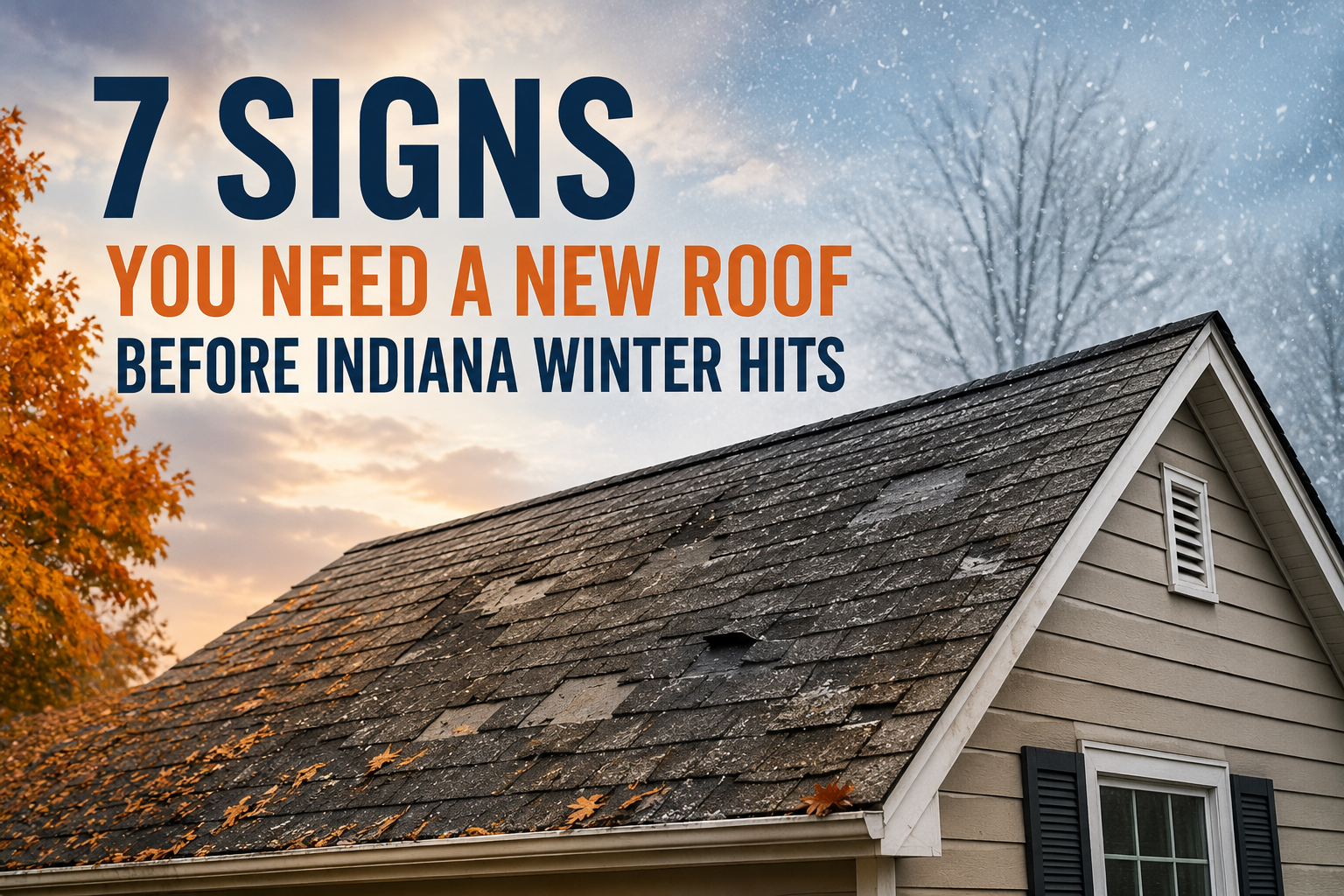
Most Michigan City homeowners don’t think about their roof until there’s a water stain spreading across the ceiling. By then, the damage has already moved past the shingles, through the underlayment, and into the decking. What started as an $800 repair is now a $14,000 conversation.
The signs you need a new roof are almost always present months or years before a failure happens. The problem isn’t that the roof doesn’t give warnings. The problem is that most homeowners don’t know what they’re looking at.
Northwest Indiana is one of the most demanding roofing climates in the entire country. Michigan City sits in the Lake Michigan snow belt, averaging 47 to over 70 inches of snow annually. The area sees 25 to 30 freeze-thaw events every winter, meaning temperatures cross the 32°F threshold in both directions dozens of times before spring arrives. Water expands 9 percent when it freezes. Every crack, every gap, every compromised seal gets a little wider with each cycle.
Indiana also recorded over 4,400 hail reports in 2022 alone, resulting in more than $1 billion in property insurance claims statewide. LaPorte and Porter County sit directly in the storm corridor that moves north through spring and summer.
Your roof works harder here than it would anywhere else in the Midwest. These are the seven warning signs you need a new roof before another Indiana winter takes that decision out of your hands.
Sign 1. Your Gutters Are Full of Dark, Sand-Like Grit
The next time you clean your gutters or walk your downspouts after a hard rain, look at what’s coming out. If you see coarse, dark material that looks like coffee grounds collecting at the base of your downspouts, that is granule loss, and it is one of the earliest signs that most homeowners completely overlook.
Asphalt shingles are coated in ceramic granules that serve two functions. They block UV radiation from breaking down the asphalt layer beneath, and they provide the impact resistance that handles hail and heavy ice. When those granules wear off, raw asphalt is exposed directly to Michigan City’s climate.
A single hail event involving stones larger than one inch can strip 30 to 40 percent of a shingle’s granule coating in minutes. That damage does not always look serious from the ground. The roof can appear intact while the granules are sitting in your gutters.
Once granule loss becomes widespread across multiple sections, you are typically 3 to 7 years from a failing roof. In a freeze-thaw climate, that window closes faster because moisture enters the exposed asphalt, freezes, expands, and physically widens the damage with each cold night. Check your gutters in spring and fall. Consistent granule buildup means a roof inspection needs to happen this season, not next year.
Sign 2. Shingles Are Curling, Cracking, or Buckling
Stand at the end of your driveway and look up at each roof slope in full daylight. Healthy shingles lie flat, tight, and consistent across every row. You are looking for three specific failure patterns.
Cupping is when shingle edges curl upward. Clawing is when the middle of the shingle bows upward while the edges stay flat. Cracking means visible splits in the shingle body, which signals the material has gone brittle. Buckling creates visible waves or ripples across a slope, often pointing to trapped moisture in the decking below or an installation problem from years back.
Any of these conditions means the shingles are no longer creating a sealed, watertight surface. In a mild climate, a curling shingle might hold together for a few more years. In Michigan City’s freeze-thaw cycle, that same shingle becomes a water entry point within one or two winters.
Asphalt shingles in cold Midwest climates typically last 15 to 25 years in real-world conditions, not the 30 years you see on the packaging. Repeated expansion and contraction from temperature swings create micro-stresses at nail lines, edges, and flashing transitions that accumulate year after year. A roof that might reach 28 years in Tennessee often hits its limit at 20 years in Northwest Indiana.
If the damage is limited to one slope, a targeted repair may buy you time. If it appears across multiple sections, replacement is the financially smarter path.
Sign 3. You Can See Daylight Through Your Attic
On a bright afternoon, go into your attic and kill every light source. Give your eyes a minute to adjust. If you see pinpoints or streaks of daylight coming through the roof boards, you have a confirmed gap in your roof system.
That gap is a water entry point during every rain. It is a cold air pathway straight into your insulation. Over time, it becomes an entry point for rodents and pests looking for warmth in winter.
While you are in the attic, do a full check. Run your hand along the underside of the roof decking and feel for soft or spongy areas, which indicate rot from long-term moisture exposure. Look for dark staining along the rafters showing where water has traveled. Check the insulation for damp patches and look along wall intersections for any mold growth.
Mold in an attic compounds quickly. Indiana’s humid summers turn a damp attic into an active mold environment within days. Remediation on top of roof replacement adds high cost and complexity.
If you see daylight coming through your attic boards, this is not a situation that waits for a convenient time. Call a contractor this week.
Sign 4. Ice Dams Formed Along Your Eaves Last Winter
This is one of the warning signs that you need a new roof, which gets dismissed as normal winter weather. It is not.
Ice dams form when heat escaping from your living space warms the upper portion of the roof deck and melts snow from underneath. That meltwater flows down toward the cold eaves where there is no heat below and refreezes into a ridge of ice. As more meltwater hits that frozen edge, it backs up and has nowhere to go except under your shingles.
From there, water works through the underlayment, soaks into the decking, and eventually shows up as a ceiling stain or water running down an interior wall. By the time you see it inside, it has been happening for days.
Water and ice damage accounts for 20 percent of all homeowner insurance claims nationally. Ice dams are among the most common winter claims filed across the Midwest. Standard Indiana homeowner policies typically cover sudden water damage caused by ice dams, but they exclude removal of the dam itself and specifically deny claims tied to long-term maintenance neglect.
The root cause of ice dams is almost always inadequate attic insulation, poor roof ventilation, or missing ice-and-water shield along the eave line. Homes built before 2000 in LaPorte County frequently lack a proper ice-and-water shield entirely. A proper roof replacement addresses the underlayment and ventilation as part of the job. Review our full roofing services to understand what a complete system replacement includes.
Sign 5. The Roof Is 20 Years Old or Older
Age alone is one of the most important signs that you need a new roof, and it requires no inspection to identify.
Manufacturer specifications rate architectural asphalt shingles at 25 to 30 years under standard test conditions. Real-world performance in cold Midwest climates consistently runs shorter. Contractors and inspectors across comparable Great Lakes markets report functional lifespans of 15 to 25 years when accounting for freeze-thaw cycling, snow loads, and seasonal hail exposure.
A roof installed in Michigan City in 2003 is at or past its practical service life in 2026, regardless of how it looks from the street.
Age matters for another reason beyond simple wear. Older roofs do not typically fail gradually with steady warnings. They hold together until a tipping point, then deteriorate fast, often triggered by one harsh winter or a single storm. The homeowners who end up in the worst financial position are those who knew the roof was old but waited for a more obvious sign. They end up replacing the roof and paying for interior water damage at the same time.
If you are in the La Porte County area and your home was built in the late 1990s or early 2000s, the original roof is likely entering that critical window now.
Sign 6. The Same Section Has Been Repaired More Than Twice
One repair in a roof’s lifetime is normal. A flashing seal fails at a chimney, a few shingles lift in a windstorm. Targeted repairs handle those fine.
The situation that costs homeowners real money is the pattern where different sections of an aging roof fail one after another over several years. A leak at the back of the house in 2021. A repair over the garage in 2023. Another section starting to lift in 2025. Each job looks like a manageable expense in isolation. Add them up and you have spent $2,500 to $3,500 on a roof that needs full replacement regardless.
When a roof reaches systemic age, the materials are failing everywhere at roughly the same rate. Repairing one section does not address the condition of the adjacent sections. You are patching a tire that has dry rot all the way around.
The practical threshold is this: when cumulative repairs over three to five years reach 30 percent or more of full replacement cost, replacement is the smarter investment. It comes with a full manufacturer warranty, eliminates annual repair uncertainty, and if you plan to sell within the next decade, a new asphalt shingle roof or metal roof delivers 51 to 61 percent ROI on resale value in the Midwest market according to Remodeling Magazine’s Cost vs. Value report.
Sign 7. Your Heating Bills Have Gone Up Without an Obvious Reason
If your gas bill has climbed over the past two or three winters without a change in habits, a new appliance, or a draft you can identify, the roof and attic system may be where the heat is escaping.
A compromised roof allows conditioned air to leave through deteriorated underlayment, failed flashing seals, and aging ridge vents. The Department of Energy estimates that a poorly performing attic and roof system can increase winter heating costs by 15 to 25 percent in cold-climate homes. In Michigan City winters, that hits your furnace directly.
Many homeowners assume the furnace is the problem and spend money on a new HVAC system. Sometimes they are right. But if the furnace checks out and the bills keep climbing, get a contractor in your attic before spending anything else.
Poor ventilation also degrades the roof from the inside out. A hot, poorly ventilated attic in summer softens the adhesive strip on shingles and shortens their lifespan. A cold, damp attic in winter creates condensation on the underside of the decking. Neither is visible from outside, and both are expensive when they eventually surface.
What to Do After Spotting These Signs
You do not need all seven. One confirmed sign is enough to schedule a professional inspection.
Document what you see from the ground with your phone before anyone touches the roof. Check the attic yourself if it is safe to access. Then call a licensed, local contractor with verifiable reviews and a physical Indiana address.
If you have had any significant storm in the past 12 months, ask specifically about an insurance claim evaluation during the inspection. Indiana policies allow 12 months from the storm date to file. That window does not move, and most homeowners have no idea how close they are to missing it.
Weldon Roofing serves Michigan City and all of Northwest Indiana, including Valparaiso, Crown Point, South Bend, and Schererville. We are GAF certified, locally owned, and will give you a straight assessment with zero pressure.
Call (219) 666-8345 or visit the contact page to schedule your inspection today.
Frequently Asked Questions
What are the most common warning signs you need a new roof in Indiana?
The most common warning signs you need a new roof in Indiana are granule loss in the gutters, curling or cracking shingles, water stains on the ceiling or attic rafters, ice dam formation along the eaves, and a roof that is 20 or more years old. In Northwest Indiana specifically, freeze-thaw cycling and lake-effect snow accelerate these failure patterns faster than the national average, which means the warning signs tend to appear earlier than homeowners expect.
How do I know if my roof damage qualifies for an insurance claim?
Indiana homeowner policies generally cover sudden storm damage including hail, high winds, falling trees, and water damage caused by ice dams. They do not cover gradual wear or age-related deterioration. If a specific storm event damaged your roof and you can date it, file the claim. Most policies allow 12 months from the storm date. Adjusters inspect and determine coverage, but you cannot collect on a claim you do not file.
Can I check the signs you need a new roof without getting on it?
Yes. From the ground you can check shingle condition, granule buildup in the gutters, visible sagging, and eave condition. From inside the attic you can see daylight through the boards, check for water staining on rafters, feel for soft or spongy decking, and look for mold. A professional inspection goes further by examining flashing integrity and underlayment condition, but the ground-level and attic checks reveal most of the major warning signs you need a new roof before a contractor ever sets foot on the slope.
How long does a roof last in Michigan City, Indiana?
Asphalt shingles are marketed at 25 to 30 years but realistically last 15 to 25 years in Northwest Indiana’s climate. The combination of lake-effect snow loads, 25-plus freeze-thaw events per winter, and Indiana’s hail season consistently reduces the functional lifespan compared to manufacturer specifications. Metal roofing performs significantly better in this climate, with a realistic lifespan of 40 to 70 years.
Does a new roof increase home value in Northwest Indiana?
It does. In the Midwest market, a new asphalt shingle roof recouped approximately 60.7 percent of its cost in resale value according to recent Cost vs. Value data. In Northwest Indiana’s real estate market, a new roof often eliminates the inspection contingency conversations that reduce sale prices or kill deals at closing. For homeowners planning to sell within 5 to 10 years, the investment in replacement pays back in both resale value and negotiating position.