
Nobody thinks about their roof until it starts leaking onto the living room carpet. That’s just how it goes. Your roof sits up there quietly, taking every bit of sun, hail, snow, and wind that comes its way, and most of us don’t look twice at it until something’s clearly wrong.
Here’s the problem, though: roofs rarely fail overnight. They wear down slowly, little by little, and the early warning signs are easy to miss if you’re not really looking for them. We’ve seen it happen over and over in this business: a homeowner puts off a small repair for a year or two, and suddenly they’re dealing with rotted decking, mold in the attic, or a much bigger bill than they expected.
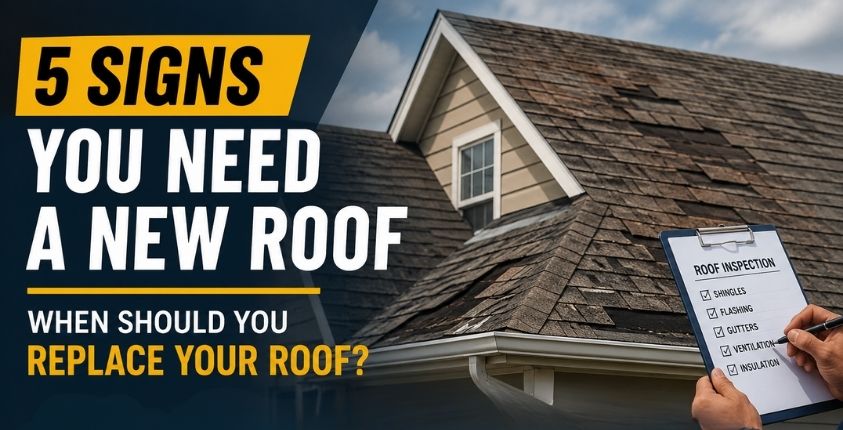
So how do you actually know when it’s time to call someone out for a repair versus when you’re staring down a full replacement? That’s what we want to walk through here. Below are the 5 signs you need a new roof, plus some straight talk on when you should replace your roof instead of just patching it up. If even one or two of these sound familiar, don’t wait around; get someone out to take a look.
1. Your Roof Is Nearing (Or Past) Its Expected Lifespan
Every roofing material has an expiration date, whether we like to think about it that way or not. Asphalt shingles, which is what most homes in the U.S. have, generally hold up for 20 to 25 years, give or take, depending on the quality of the install and how brutal your local weather tends to be. Architectural shingles buy you a bit more time, closer to 30 years. Metal, tile, and slate can go even longer.
If you know roughly how old your roof is and it’s creeping up on that range, or already past it, that’s reason enough to start thinking seriously about replacement. Even if it looks fine from your driveway. Here’s the thing about roofing materials: they break down from the inside out. So a roof can look perfectly presentable while it’s already failing where you can’t see it.
Not sure how old yours is? Pull up the inspection report from when you bought the house, or just ask a contractor to take a guess based on the wear patterns and materials. This is often the very first clue that you’re going to need a roof replacement, sometimes long before any obvious damage shows up.
For homeowners asking when you should replace roof systems that are getting older, the answer depends on more than age alone. The overall condition of the roofing system matters just as much.
2. Shingles Are Curling, Cracking, or Just Gone
Walk around the outside of your house sometime and actually look up. Not a quick glance, an actual look. Healthy shingles lay flat against the roof, all in a uniform line. If you’re spotting shingles that curl at the edges, crack down the middle, or are just missing altogether, your roofing material is telling you it’s on its way out.
Curling shows up in two forms: cupping, where the edges lift up like a bowl, or clawing, where the edges dip down while the middle pokes up. Either way, it usually comes down to age, bad attic ventilation, or too much direct sun exposure over the years. And either way, it means your shingles have stopped sealing properly, which is bad news the next time it rains sideways.
Cracking tends to come from thermal cycling and the shingles expanding and contracting with every hot day and cold night until the material just gives out. Missing shingles are even more urgent, since they leave your roof deck completely bare and exposed to the next storm that rolls through.
A handful of damaged shingles scattered here and there? That can usually be repaired without much fuss. But once the damage is spread across large chunks of the roof, you’re probably looking at a system that’s simply worn out.
These are some of the most recognizable 5 signs you need a new roof, particularly when shingle damage appears across multiple areas instead of being limited to one isolated spot.
3. You’ve Got Water Stains or Actual Leaks
A water stain on your ceiling is one of the most obvious signs something’s wrong, but it’s also kind of a deceiving one. By the time it shows up on your drywall, water has probably been sneaking in for a while already. That stain is the tail end of the problem, not the beginning.
Keep an eye out for other clues too: a musty smell when you go up into the attic, mold or mildew you can actually see, paint peeling near where the roof meets the wall, or insulation that feels damp or looks flattened out. In the worst cases, you’ll notice the roof deck itself starting to sag, which usually means the wood underneath has soaked up moisture and started to weaken.
And leaks don’t always come from some big obvious hole either. A lot of the time it’s failed flashing around a chimney or vent pipe, seals that have worn out, or shingles that just can’t shed water like they used to. If you keep getting leaks even after having repairs done, that’s usually a sign the problem is bigger than any one spot, and at that point, a full roof replacement tends to save you money in the long run compared to chasing leaks one at a time.
If recurring leaks are making you wonder whether you need a roof replacement, don’t assume another quick patch will solve the problem. The roof needs to be evaluated as a whole.
4. Your Gutters Are Full of Granules
Asphalt shingles have a coating of small mineral granules on them that shield against UV rays and help with fire resistance. New shingles shed a few loose granules here and there; that’s totally normal. But as shingles get older, that shedding speeds up a lot, and it’s a sign the protective layer is wearing thin.
Take a look in your gutters, or even at the ground near your downspouts. If you keep finding what looks like coarse sand piling up, that’s your shingles telling you they’re on the way out. Once that granule coating is gone, the shingles underneath are exposed to direct sun, and that speeds up cracking, curling, all of it.
This one’s easy to miss because it’s not dramatic like a leak dripping onto your floor. But granule loss is honestly one of the earliest 5 signs you need a new roof; it often shows up well before anything else on this list becomes obvious.
If you’re researching when should you replace roof because you’ve noticed excessive granules around your home, consider the roof’s age and whether other warning signs are present before making a decision.
5. The Roofline Is Sagging or Uneven
This one’s serious, and it’s not something to put off. Stand back across the street and look at your roof as a whole. It should read as a straight, even line. Any dips or sags you can see usually point to a structural issue underneath, often from water damage that’s gone on too long, rotted decking, or the weight of too many layers of old roofing piled on top of each other.
Sometimes sagging traces back to something in the attic, like rafters or trusses that have weakened and can’t hold things up the way they should anymore. This isn’t a patch-it-yourself situation. A sagging roof calls for a professional structural assessment, and soon, because it can point to a risk that goes beyond just the roof itself.
If you spot any sagging, stay off the roof and get a professional out there right away.
A sagging roof is among the more serious 5 signs you need a new roof, although the exact solution still depends on what the inspection finds underneath the visible roofing materials.
So… Repair or Replace?
Not every problem means you need a whole new roof. A handful of cracked shingles after a bad storm, or a small leak around a vent pipe that’s usually a fixable repair without much cost or hassle.
Replacement starts to make more sense once:
- Your roof is at or past its expected lifespan
- The damage is spread out across the roof rather than confined to one spot
- You keep getting leaks in different places, even after repairs
- Repair costs keep piling up and start getting close to what a full replacement would run
- You’re getting ready to sell and want the curb appeal (and the resale value) that comes with a new roof
If you’re trying to figure out when you should replace roof systems instead of continuing with repairs, look at the bigger picture. Several problems occurring together are usually more meaningful than one isolated defect.
Honestly, the best move is to have a roofer walk the roof with you and give it to you straight. Choosing a contractor with experience in best roofing construction practices can also help ensure the work is done correctly and built to last.
A Professional Look at Your Roof’s Condition
We’ve been doing this a long time, and one thing we’ve learned is that homeowners don’t want a sales pitch; they want the truth. At Weldon Roofing, we walk your roof, tell you exactly what we find, and lay out your options whether that’s a simple repair or a full replacement. No pressure, no upselling you into something you don’t need.
If any of the signs above sound familiar, or you’re just not sure what shape your roof is in, give us a call and we’ll come take a look. Catching a problem early almost always costs less than waiting, and it means one less thing to worry about the next time a storm rolls through.
If an inspection shows that you need a roof replacement, we’ll explain what we found and help you understand the available options before you make a decision.
Frequently Asked Questions
1. How often should I have my roof inspected?
Most roofing professionals recommend an inspection at least once a year, ideally in the spring or fall, plus an additional check after any major storm. Regular inspections catch small issues before they turn into costly repairs.
2. Can I replace just part of my roof instead of the whole thing?
In some cases, yes, especially if the damage is limited to one section and the rest of the roof is still in good condition. However, mismatched materials and uneven aging can sometimes create more problems down the line, so it’s worth getting a professional opinion first.
3. How long does a roof replacement typically take?
For most residential homes, a full roof replacement takes anywhere from one to three days, depending on the size of the roof, the materials used, and weather conditions. If you’re wondering when you should replace roof materials based on their condition rather than the installation schedule, an inspection can help you make that decision first.
4. Will homeowners insurance cover the cost of a new roof?
It depends on the cause of the damage. Insurance often covers roof replacement if the damage resulted from a covered event, like a storm or fallen tree, but it typically won’t cover damage from normal wear and aging. Check your policy or ask your insurer directly for specifics.
5. What’s the average cost of a roof replacement?
Costs vary widely based on your roof’s size, the materials chosen, and your location, but most homeowners can expect a range depending on these factors. A roofing contractor like Weldon Roofing can provide a detailed, no-obligation estimate based on your specific home.
If the inspection shows that you need a roof replacement, getting a detailed estimate can help you understand the scope of work and the factors affecting the overall cost.