
If you own a home near Lake Michigan and you’re past the point of just patching another round of asphalt shingles, you’ve probably started looking at tile, slate, and copper roofing. All three show up a lot in older lakefront neighborhoods, all three last a lot longer than standard shingles, and all three cost more upfront.
Beyond that, they’re pretty different products solving slightly different problems, and picking the wrong one for your specific home is an expensive mistake to walk back.
Here’s how tile, slate, and copper roofing actually compare, what each one is genuinely good at, and what tends to matter most for homes that deal with real lakefront weather.
Why Lakefront Homes Lean Toward These Materials in the First Place
Standard asphalt shingles are built for average weather. A home a mile inland deals with rain and the occasional windstorm. A home sitting closer to Lake Michigan deals with stronger, more sustained wind, higher humidity, bigger temperature swings between seasons, and the kind of freeze-thaw cycling that wears down a cheaper roof faster than the warranty expects.
That’s the whole reason tile, slate, and copper roofing show up so often in these neighborhoods. They’re not just a style choice, they’re built to hold up to conditions asphalt wasn’t really designed for.
Tile Roofing
Tile roofing, usually clay or concrete, is one of the more durable options available, and it’s a common choice for homeowners who want both longevity and a distinct architectural look.
A well installed tile roof can last several decades, often outliving multiple asphalt roof replacements over the same period.
What it’s good at: tile handles wind, sun exposure, and moisture well, and it doesn’t rot, warp, or attract insects the way some other materials can. It’s also low maintenance once installed correctly, you’re not looking at frequent upkeep the way you might with some alternatives.
What to watch for: tile is heavier than asphalt shingles, which means your roof structure needs to be able to support it, this is something a contractor should check before recommending it, not after.
It’s also more brittle underfoot than some materials, foot traffic for things like chimney repairs or gutter work needs to be handled carefully to avoid cracking individual tiles.
Best for: homeowners who want a long-term, low-maintenance roof and are comfortable with the higher upfront investment compared to asphalt. In a tile vs slate roofing comparison, tile tends to be the more budget-friendly of the two premium options, while still delivering serious durability.
Slate Roofing
Slate is natural stone, split into thin tiles, and it’s about as durable as roofing material gets. Some slate roofs last well over a century with proper care, which is part of why you’ll see it on a lot of older, well-built homes in lakefront communities.
What it’s good at: slate is essentially immune to rot, insects, and fire, and it holds up extremely well against wind and moisture, exactly the conditions a lakefront home deals with regularly. It also has a distinct, high-end appearance that’s hard to replicate with other materials.
What to watch for: slate is heavy, similar to or heavier than tile, and it requires a contractor who’s actually experienced working with it. Repairs need to match the existing slate, and improperly matched or improperly flashed repairs are one of the more common ways a slate roof develops leaks over time. This isn’t a material where you want a contractor learning on your roof.
Best for: homeowners planning to stay in the home long term, or who value maximum lifespan over minimizing upfront cost. In a tile vs slate roofing decision, slate is typically the longer lasting of the two, though also usually the more expensive option and the pickier one to install and repair correctly.
Copper Roofing
Copper roofing is a different category entirely, a metal roofing option rather than a tile or slate one, and it’s usually chosen as much for its distinctive look as for its performance.
It develops a natural patina over years of exposure, shifting from bright copper tone to a muted green or brown finish, which is part of the appeal for a lot of homeowners rather than something to avoid.
What it’s good at: Copper roofing is extremely durable against wind and moisture, doesn’t corrode the way some metals can, and is significantly lighter than tile or slate, which makes it a realistic option on homes where the structure can’t support heavier materials. It’s also one of the longest-lasting roofing materials available when properly installed.
What to watch for: copper roofing is a specialty install, and it needs a contractor who understands proper fastening and expansion joints, since copper expands and contracts with temperature more than some other materials. Get this wrong and you end up with premature seam failures.
Best for: homeowners who want a distinctive, long-lasting roof and don’t mind the material’s appearance changing over time as the patina develops. Copper roofing is also a strong choice specifically where roof weight is a real constraint, since it doesn’t carry the same structural demands as tile or slate.
Side by Side
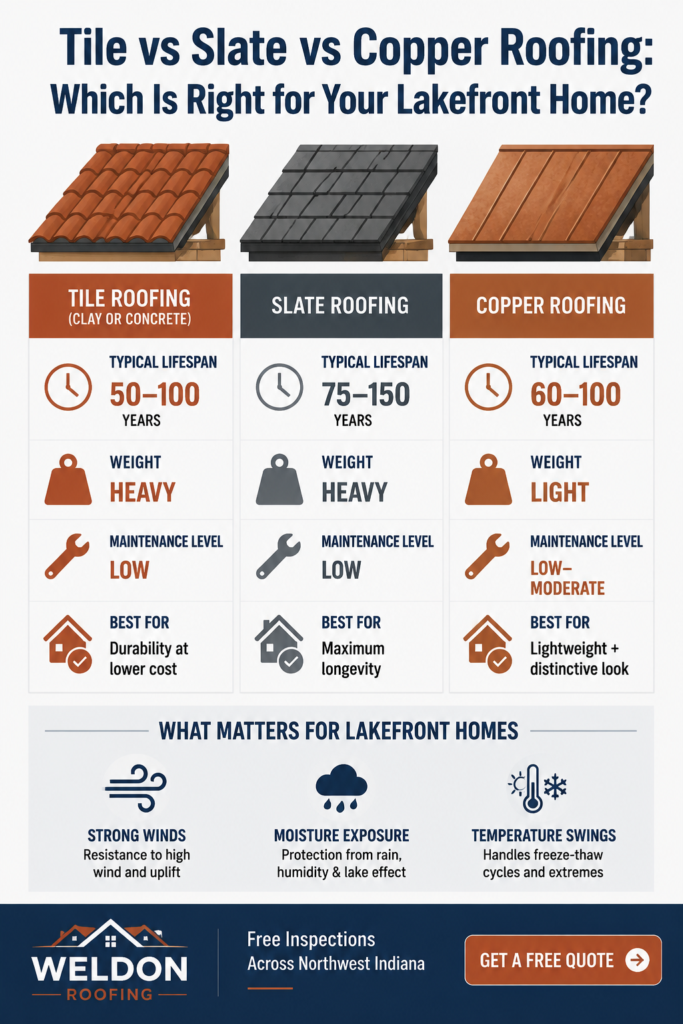
| Tile | Slate | Copper Roofing | |
|---|---|---|---|
| Typical lifespan | 40-60+ years | 75-100+ years | 50-100+ years |
| Weight | Heavy | Heavy | Light |
| Maintenance | Low | Low, but repairs need a specialist | Low |
| Best known for | Durability + architectural style at a lower cost than slate | Maximum longevity + high-end look | Distinctive appearance + low weight |
| Repair difficulty | Moderate, brittle underfoot | High, needs matched material and an experienced installer | High, needs proper expansion joint work |
What Actually Matters Most for a Lakefront Home
If you’re weighing tile vs slate roofing specifically for a home near Lake Michigan, structure is usually the deciding factor before style is. Tile and slate are both heavy, and not every roof frame, especially on older lakefront homes, is built to carry that load without reinforcement. That’s not a reason to rule either one out, but it is something a contractor needs to actually check, not assume.
Copper roofing sidesteps that issue entirely because of how light it is relative to tile and slate, which is why it often comes up as the practical choice on homes where a structural engineer has flagged weight as a concern, or where the existing roof deck simply wasn’t built for a heavier material.
Beyond structure, all three genuinely outperform standard asphalt shingles against the wind and moisture exposure that comes with living on the lake. The right choice usually comes down to how long you’re planning to stay in the home, what your roof structure can support, and which look actually fits the house.
Questions Worth Asking Before You Decide
Has anyone actually checked whether my roof structure can support this material? This should happen before you fall in love with a look, not after.
How many tile, slate, or copper roofing jobs has this contractor actually completed? These aren’t materials where general roofing experience automatically transfers. Ask specifically.
What does the repair process look like for this material down the road? Every roof eventually needs a repair. Understanding how hard that repair will be, and whether your contractor can actually do it, matters as much as the initial install.
Does my homeowners insurance treat these materials differently? Some policies handle premium roofing materials differently than standard shingles, both in terms of premiums and how a storm damage claim gets valued. Worth a conversation with your insurer before you commit. If you do end up filing a storm damage claim down the road, our insurance claim guide walks through the process.
FAQ
Is tile or slate roofing better for a lakefront home?
Both hold up well against wind and moisture. Tile tends to be the more budget-conscious of the two premium options, while slate typically lasts longer and carries a higher price tag. The right pick usually depends on how long you plan to own the home and what your roof structure can support.
Is copper roofing worth the cost?
For homeowners who want a distinctive, extremely long-lasting roof and either like the look of a developing patina or need a lighter-weight material than tile or slate, copper roofing is generally considered worth the investment. It’s not the right fit for someone who wants a roof that looks static and unchanging over decades, since the patina process is part of the material.
Can any roofing contractor install tile, slate, or copper roofing?
Not well. These are specialty installs, and a contractor without direct experience in the specific material can make mistakes that don’t show up as leaks until years later. Ask about direct experience with the exact material you’re considering, not just general roofing experience.
Do these materials need more maintenance than asphalt shingles?
Generally less, day-to-day. Where they differ is repair complexity. A basic asphalt shingle repair is usually straightforward. A tile, slate, or copper roofing repair needs a contractor who actually knows the material, which is a smaller pool of people to choose from.
Talk to Someone Who Actually Installs These
We install and repair tile, slate, and copper roofing for homeowners throughout Beverly Shores and the surrounding lakefront communities, including Michigan City. If you’re trying to decide between tile vs slate roofing, or wondering whether copper roofing makes more sense for your specific home, request a free inspection , and we’ll walk the roof, check what your structure can actually support, and give you a straight answer instead of just steering you toward whichever material is easiest to sell.