
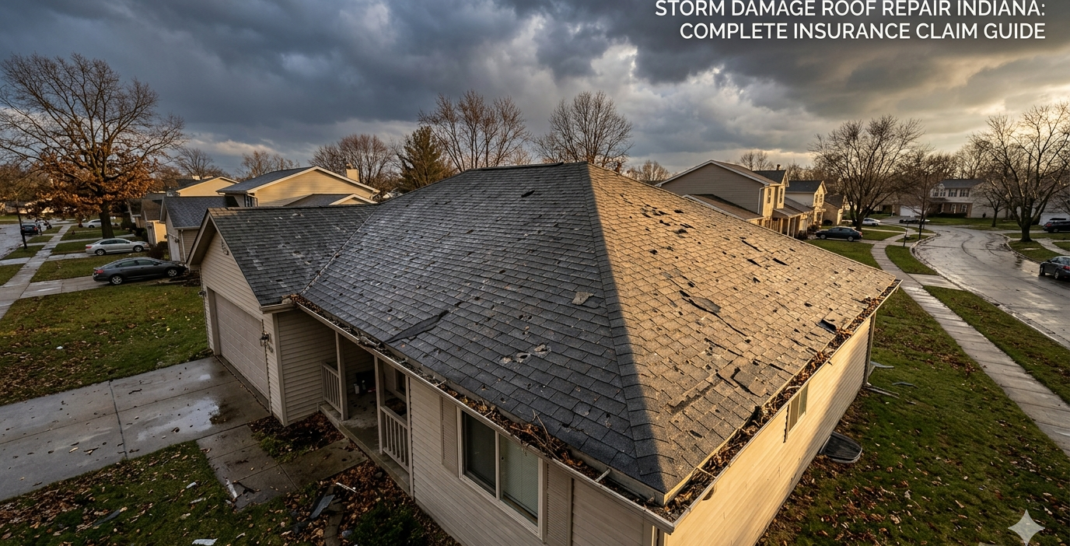
Hail & Storm Damage Roof Repair in Michigan City, Indiana
Before we talk about insurance, you need to understand why your roof is under more stress than roofs in Indianapolis or Evansville.
Northwest Indiana sits in what meteorologists call the Lake Michigan Snow Belt, a corridor where cold Arctic air masses pull moisture directly off Lake Michigan and dump it as heavy snow, freezing rain, and ice on communities from Michigan City to Merrillville. Add spring hailstorms from Gulf air colliding with cold fronts, and summer straight-line winds that regularly exceed 60 mph, and you have one of the most demanding roofing environments in the Midwest.
What this means for your roof:
- Lake-effect ice dams: form when snow melts and refreezes at the roof’s cold edge, forcing water under shingles — a uniquely NW Indiana problem that causes interior damage most homeowners don’t discover for months.
- Hail frequency: La Porte and Porter counties average 3–5 significant hail events per year, with stones regularly reaching 1 inch in diameter — large enough to crack asphalt shingles and bruise fiberglass mats.
- Wind uplift: Sustained winds off Lake Michigan create negative pressure on your roof deck, pulling shingles from the ridge down — a failure pattern that standard repairs cannot adequately address.
- Freeze-thaw cycles: Michigan City averages 80+ freeze-thaw cycles per winter, expanding and contracting flashing, caulking, and ridge caps until they fail.
This is precisely why a professional roof inspection by a contractor who understands NW Indiana’s specific climate is non-negotiable after any significant weather event.
Does Homeowners Insurance Cover Storm Damage to Your Roof in Indiana?
Direct answer: Yes, with conditions.
Indiana homeowners insurance policies cover roof damage from sudden, accidental weather events. This includes:
Covered
- Hail impact damage
- Wind damage (shingle loss, uplift)
- Ice dam water intrusion
- Fallen tree or branch damage
- Lightning strike
- Storm-driven debris
Not Covered
- Normal wear and tear
- Age-related deterioration
- Improper installation
- Pre-existing damage
- Neglect or deferred maintenance
- Cosmetic damage only (some policies)
The critical factor: Your insurer will determine whether damage is storm-caused or pre-existing. This is why documenting damage immediately after a storm, before any additional weathering occurs, is essential.
ACV vs. RCV — The Policy Difference That Changes Your Payout by Thousands
Before filing any roof insurance claim in Indiana, open your policy and find these two letters under “Loss Settlement.”
Actual Cash Value (ACV)
ACV pays the depreciated value of your roof — what it’s worth today, not what it costs to replace it. The older your roof, the less you receive.
Real example: 15-year-old asphalt roof, $18,000 replacement cost, 60% depreciation = $7,200 payout. You cover the remaining $10,800 out of pocket.
Replacement Cost Value (RCV)
RCV pays for a brand-new roof of equivalent quality, regardless of age. Payment arrives in two checks:
Initial payment = replacement cost minus your deductible
Depreciation release = paid after your licensed contractor completes the job
Same example with RCV: $18,000 roof, $2,000 deductible = $16,000 total payout.
Other Policy Terms That Affect Your Claim
Cosmetic damage exclusion: Some newer policies exclude coverage for dents, dings, or hail marks that don’t compromise the roof’s waterproofing function. This is increasingly common — check your policy.
Matching clause: Indiana has no statutory matching requirement, meaning your insurer may only replace damaged sections rather than the full roof, even if new shingles don’t match your existing ones. Understanding this upfront helps you negotiate.
Wind/hail deductibles: Some Indiana policies carry a separate, higher deductible specifically for wind and hail claims — sometimes 1–2% of your home’s insured value rather than a flat dollar amount. On a $300,000 home, that’s a $3,000–$6,000 deductible.
7 Types of Storm Damage You Must Document
Our team at Weldon Roofing has sat alongside adjusters on hundreds of inspections across Michigan City, La Porte County, Porter County, and Lake County. These are the seven damage types that adjusters most commonly underreport, and that our documentation routinely recovers:
1. Hail bruising (fiberglass mat fracture)
Hail impact creates circular depressions where granules are knocked away, exposing the asphalt layer beneath. The fiberglass mat underneath is often fractured — invisible to the untrained eye but catastrophic for long-term waterproofing. The insurance threshold in most Indiana policies: 6 hits per 10×10-foot area = full replacement warranted.
2. Lifted and creased shingles from wind
Wind uplift breaks the factory seal strip between shingles. Shingles may lie flat after the wind stops, but the bond is broken permanently. Water will eventually find its way under them. Adjusters frequently miss this because it requires lifting each shingle to inspect the seal.
3. Flashing separation at penetrations
Chimney, skylight, pipe boot, and ridge vent flashing are the first points to fail in high-wind events. Even a 1/4-inch separation at a chimney flashing can allow gallons of water intrusion per rainfall. This is rarely included in initial adjuster estimates.
4. Ice dam damage to decking and interior
Ice dams force meltwater horizontally under shingles and into your attic. By the time you see a ceiling stain, the damage has been accumulating for weeks. Document attic moisture, insulation saturation, and any visible deck staining — all of this is covered under most Indiana policies.
5. Granule accumulation in gutters
After any hailstorm, inspect your gutters. Heavy granule loss — measured in cups, not teaspoons — indicates shingles have been stripped of their UV protection and waterproofing layer. This is one of the strongest indicators of an insurable hail event.
6. Soft metal damage as proxy evidence
Hail that damages your roof always leaves evidence on softer metals first: gutters, downspouts, window screens, AC condenser fins, and painted metal fascia. Photograph every dent. Adjusters use soft metal damage as the primary calibration point for hail size, and it’s your strongest claim evidence.
7. Ridge cap and hip shingle damage
Ridge caps take the most direct hail and wind impact of any part of your roof. They’re also the most expensive per-square-foot to replace. Always have these specifically inspected — adjusters often include a line item for ridge replacement only if explicitly documented.
Our roof inspection process covers all seven of these damage types with photographic documentation formatted for insurance submission.
The Complete Step-by-Step Insurance Claim Process for Indiana Homeowners
Step 1: Document Everything Before Any Repairs
Within 24 hours of any storm, photograph and video from ground level:
- Full roof from every angle and elevation
- Close-up shots of visible shingle damage and missing sections
- Gutters and downspouts (granule buildup)
- All soft metal surfaces — gutters, downspouts, AC units, screens
- Interior water stains, ceiling damage, attic moisture
- Storm debris in yard — hail samples, shingle pieces, branches
Step 2: Call a Local Certified Contractor Before Your Insurance Company
This is the step that changes your claim outcome most.
- Perform a free roof inspection and produce a written damage report
- Photograph damage at roof level with professional documentation
- Give you an accurate replacement cost estimate
- Prepare you for exactly what the adjuster will, and won’t, flag
Now you negotiate from knowledge, not hope. Call or text (219) 587-5943 to schedule within 48 hours of any storm.
Step 3: File Your Claim With Full Documentation
When contacting your insurer, have ready:
- Exact storm date and time
- Your complete photo library with timestamps
- Your contractor’s written damage assessment
- Emergency repair receipts (tarps, materials — all reimbursable)
- Your policy number and deductible amount
Request the assigned adjuster’s name and direct contact immediately.
Step 4: Have Your Contractor Present at the Adjuster Inspection
The adjuster works for your insurance company. They inspect multiple properties per day under time pressure and may not be roofing specialists. Their job is to document damage accurately, but they miss things routinely. With your contractor present:
- Every damage point is walked through systematically
- Flashing failures, soft metal evidence, and hidden granule loss are formally documented
- Industry standards (Haag Engineering protocols, NRCA guidelines) are referenced on-site
- Anything the adjuster skips is formally noted for supplement filing
Step 5: Review the Scope of Loss Line by Line
Check your adjuster’s written estimate against your contractor’s report for:
- Correct damage cause identified (wind vs. hail affects deductible)
- All damaged areas listed — ridges, valleys, flashings, penetrations
- Accurate material specifications (architectural vs. 3-tab shingles)
- Indiana code upgrade items included (ice & water shield, synthetic underlayment, drip edge)
- Reasonable depreciation percentages
Step 6: File a Supplement If the Estimate Is Too Low
A supplement is a formal, documented dispute — standard practice in the roofing industry. It includes:
- Line-by-line comparison against the adjuster’s scope
- Current regional material pricing
- Photo evidence for every disputed item
- Indiana building code citations requiring specific materials
Step 7: Understand Your Payment Structure
- ACV policy: Single payment = replacement cost minus depreciation minus deductible.
- RCV policy: Two payments — initial ACV check, then depreciation release after completed work.
If your mortgage lender is listed on your policy, expect checks payable to both you and your lender. The lender’s loss draft process adds 1–3 weeks — plan accordingly.
What to Do If Your Roof Insurance Claim Is Denied in Indiana
A denied roof insurance claim in Indiana is not the end. You have four concrete options:
1. Request a re-inspection
Ask your insurer to send a second adjuster, especially after new documentation or a contractor-identified damage assessment.
2. Invoke the appraisal clause
Most Indiana policies include an appraisal clause. Both parties hire independent appraisers who agree on a neutral umpire. The umpire’s value determination is binding. Cost: $500–$1,500. Result: routinely produces significantly higher settlements than the original denial.
3. File a complaint with the Indiana Department of Insurance
At doi.in.gov, the IDOI investigates bad-faith claim handling and can compel reconsideration. Free to file.
4. Hire a licensed Indiana public adjuster
A public adjuster works on your behalf, not the insurer’s, and takes 10–15% of the final settlement. Valuable for complex or high-dollar denials.
Choosing the Right Roofing Contractor for Your Insurance Claim
Not every roofing contractor is equipped to handle insurance claims. The process requires documentation expertise, adjuster experience, and supplement negotiation skills that most general contractors don’t have.
Choosing the Right Roofing Contractor for Your Insurance Claim
Not every roofing contractor is equipped to handle insurance claims. The process requires documentation expertise, adjuster experience, and supplement negotiation skills that most general contractors don’t have.
When evaluating contractors, ask these specific questions:
- Are you GAF Certified or hold another manufacturer certification? (Weldon Roofing is GAF Certified)
- Do you carry both general liability and workers’ compensation insurance in Indiana? (Request certificates)
- Will you be present at the adjuster inspection?
- Do you handle supplement filing if the initial estimate is insufficient?
- Do you pull the required building permits in La Porte, Porter, and Lake Counties?
- Can you provide references from local insurance claim jobs completed in the last 12 months?
We install asphalt shingles, metal roofing, and flat/EPDM roofing systems, so whatever your home requires after a storm, we have the certified expertise to install it correctly the first time.
Indiana Law: What Your Contractor Cannot Do
Indiana has specific statutes protecting homeowners from contractor fraud following storm events:
Deductible waiver is illegal. Under Indiana Code IC 27-1-15.6-17, it is unlawful for a contractor to offer to pay, waive, or absorb a homeowners insurance deductible as an inducement to contract. Any contractor making this offer is committing insurance fraud — and so is the homeowner who accepts.
Assignment of Benefits (AOB) restrictions. Indiana limits the use of AOB agreements that allow contractors to directly control and collect insurance benefits. Be cautious of any contractor asking you to sign over your claim rights.
Contractor licensing. Roofing contractors in Indiana are not required to hold a state license, but must have proper liability insurance and workers’ compensation coverage. Always request current certificates of insurance before signing any contract.
Right of rescission. Under Indiana’s Home Improvement Contract Act, you have 3 business days to cancel any home improvement contract over $150 signed at your residence, even after signing. Use this if a storm chaser pressures you into an immediate decision.
5 Red Flags: Storm Chaser Roofing Scams in Indiana
After every major hail event in Valparaiso, Merrillville, Crown Point, and Michigan City, out-of-state crews flood the area within 48–72 hours.
- 🚩 Unsolicited door-knocking within 24–48 hours of a storm
- 🚩 Pressure to sign immediately — legitimate contractors give you time to decide
- 🚩 Offer to waive your deductible — this is insurance fraud under Indiana Code IC 27-1-15.6-17
- 🚩 No verifiable local Indiana address — a PO box or out-of-state location is disqualifying
- 🚩 No manufacturer certification — GAF, Owens Corning, or CertainTeed certifications are earned, displayed, and verifiable
Verify every contractor on Google: look for reviews mentioning specific Indiana cities, check how long the Google Business Profile has existed, and confirm the address is a real local office, not a PO box or out-of-state location.
After Your Roof Is Replaced: Protecting Your Investment
A new roof replacement is only as good as the maintenance that follows. Here’s what Weldon Roofing recommends for every Northwest Indiana homeowner post-installation:
- Annual inspection: Schedule every fall before lake-effect season begins. We offer roof inspections to all past customers.
- Gutter cleaning: Twice yearly, spring and fall. Clogged gutters cause ice dam conditions.
- Attic ventilation check: Poor ventilation accelerates shingle deterioration and contributes to ice dam formation.
- Document your installation: Keep your contractor’s warranty, manufacturer’s warranty, and installation photos — you’ll need these for any future claim.
- Update your insurer: After a replacement, notify your insurer of the new roof’s age and material. It may reduce your premium and affects future claim calculations.
Frequently Asked Questions — Storm Damage & Roofing Insurance in Indiana
Q: What is storm damage roof repair and when do I need it?
Storm damage roof repair in Indiana refers to fixing or replacing roofing materials damaged by hail, wind, ice dams, or fallen trees. You need it whenever a weather event has compromised your roof’s waterproofing, structural integrity, or shingle coverage — even if damage isn’t visible from the ground. A free professional inspection is always the first step.
Q: Does homeowners insurance cover roof replacement in Indiana for all storm types?
Yes — most Indiana policies cover hail, wind, ice dam, and storm debris damage. Exclusions typically include wear and tear, pre-existing conditions, and damage from neglect. Always review your policy’s “Covered Perils” section and consult your agent if anything is unclear before storm season begins.
Q: How do I file a roof insurance claim in Indiana the right way?
Document damage with timestamped photos, call a GAF-certified local contractor before your insurer, file your claim with full documentation, be present at the adjuster inspection with your contractor, and review the Scope of Loss carefully. If the estimate is too low, your contractor files a supplement. See the full step-by-step process in this guide above.
Q: How long do I have to file a hail damage insurance claim in Northwest Indiana?
Indiana law allows 2 years from the storm date. However, individual policies often specify 12 months. File as soon as possible — the longer you wait, the harder it becomes to prove damage is storm-related rather than wear-and-tear.
Q: What does a hail damage roof repair in Michigan City Indiana typically cost out of pocket?
With an RCV policy and an approved claim, your out-of-pocket cost is typically only your deductible — $1,000–$2,500 for most Indiana homeowners. With ACV coverage on an older roof, out-of-pocket costs can reach $8,000–$15,000. Policy type is the determining factor.
Q: My roof insurance claim was denied in Indiana — what should I do?
Don’t accept the denial as final. Request a re-inspection with new documentation, invoke your policy’s appraisal clause for an independent valuation, or file a complaint with the Indiana Department of Insurance at doi.in.gov. Most denials are based on incomplete documentation — a proper supplement filing resolves the majority.
Q: How do I dispute a roof insurance claim that was undervalued?
Your contractor submits a supplement — a documented line-by-line dispute supported by material cost data, photos, and Indiana building code citations. This is standard industry practice.
Q: What is the difference between roof repair and full replacement for an insurance claim?
Insurers approve full replacement when damage is widespread, typically 25–30%+ of the total roof surface, or when matching isolated sections is not feasible. Localized damage may result in a repair approval. Your contractor’s documentation and the adjuster’s scope together determine this threshold. See our roof repairs page for what this looks like in practice.
Q: Can I choose my own contractor for an insurance-covered roof replacement in Indiana?
Yes, you have the legal right to choose any licensed contractor in Indiana. Your insurer may suggest preferred vendors, but you are not obligated to use them. Choose a contractor with local experience, manufacturer certification, and verifiable reviews from Indiana homeowners.
Q: Is ice dam damage covered by homeowners insurance in Indiana?
Yes, ice dam water intrusion is covered under most Indiana homeowners policies as sudden, accidental damage. Document attic moisture, wet insulation, and interior water stains immediately. This is a uniquely Northwest Indiana claim type that many out-of-area adjusters undervalue — having a local contractor present at the inspection is essential.
Q: What areas does Weldon Roofing serve for storm damage roof repair in Indiana?
We serve all of Northwest Indiana — Michigan City, La Porte County, Porter County, Lake County, Valparaiso, Merrillville, Crown Point, Hobart, Chesterton, Schererville, Dyer, Griffith, and surrounding communities.
Q: Do you install asphalt shingles and metal roofing for insurance approved replacements?
Yes. We install asphalt shingles, metal roofing systems, and flat/EPDM roofing — all materials and all roof types. If you want to upgrade from your approved material, you pay only the cost difference. We coordinate this directly with your insurer.